A Nothing That Is a Something
"'Space' is so... douchey." Or is it?

Hello angels,
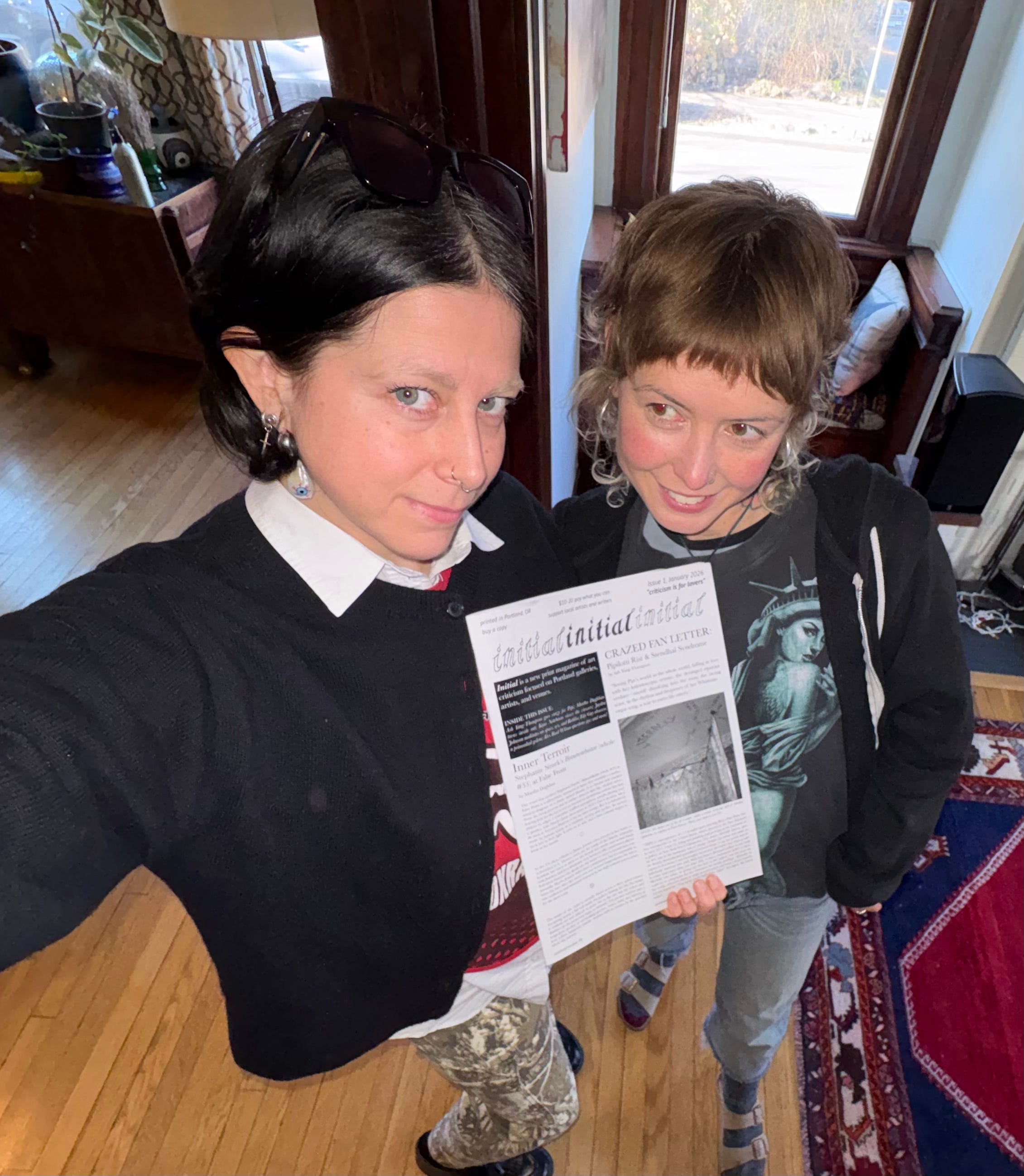
Below is an excerpt from the essay I wrote for Initial, the magazine of Portland-focused arts writing I started with pal Martha. Here is us with the print proof:
We are super excited about the writing and art in issue 1 and hope to see you at the launch party this Friday at 7pm at Mother Foucault’s. In addition to a generally convivial atmosphere replete with off-brand seltzer and the bottle of pre-mixed Negroni my neighbor gave me as a housewarming gift, we’ll have some short readings and talks from contributors. At a typewriter table, you’ll be able to respond to work in the issue (and potentially appear in the next one!). We will also have a piñata you can beat the shit out of in the back garden, which supports Virtua Gallery and a local piñata maker whose store burned down and whose son was kidnapped by ICE. What will be inside? What other grim surprises await at the party? Time will tell!
Initial will have a website, but we hope the magazine will be a tool to further connect the local arts community. To that end, attending an event or visiting a stockist (MF’s, Nationale, others TBD) in person to purchase will be strongly encouraged for those who are able. Formal information about ways for out-of-towners to purchase the mag are forthcoming, but for now you can Venmo me with your preferred shipping name and address in the comment field. Issues are $10-20 pay what you can. Media mail postage is, what, $1.50?
Here’s some of what I wrote for the mag on the occasion of the opening of the Rothko Pavilion at the Portland Art Museum. “What is the fucking deal with this guy?” I dared to ask. “Why is everyone so obsessed with his boring old paintings?” Thank you as always for reading <3
It is midnight and I am rotting on the couch in my boyfriend A’s studio apartment. He asks me what I wrote about today. I say Rothko. A is tired. His blue eyes are pink. And yet he launches into a litany on Rothko and his Chapel, a room that I sat in a room and read about all day.
The Chapel, whose design Rothko based on Roman Catholic architecture and the spiritual experiences he had in Italy, was one of his last big projects. For the interior of the space, the artist painted fourteen huge panels a deep purple-black. These are hung in triptychs or singly on each of the eight walls of the octagonal interior. In the center is a cluster of darkly-stained wood benches. Seated there, the viewer finds herself surrounded by darkness, save the light leaking in around the black octagon that covers the chapel’s skylight.
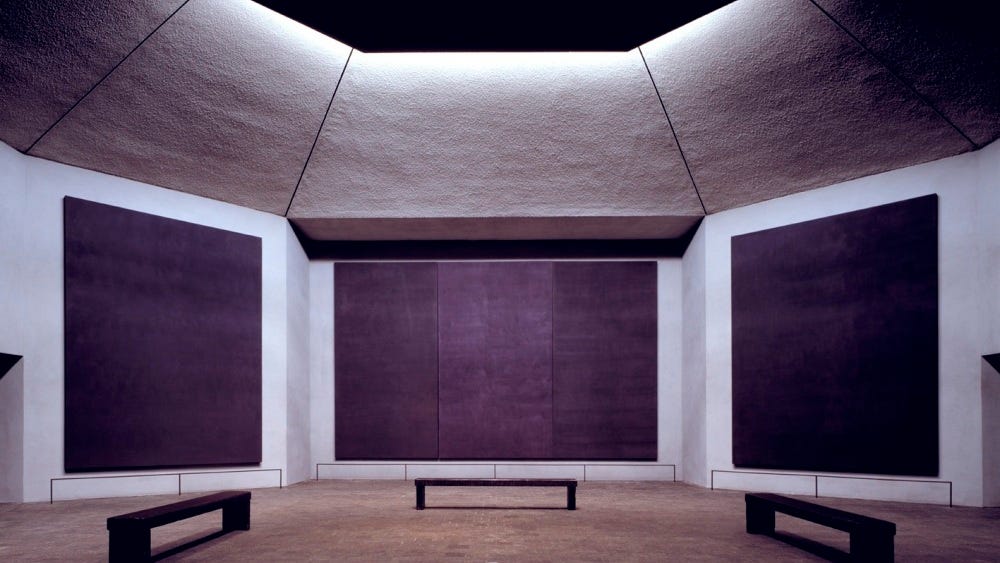
The panels in the Chapel are the fullest expression of Rothko’s signature style. They are color fields, the name given to his large scale, abstract paintings of blurry-edged rectangles painted in bold hues. He built them from dozens of layers of color on color using acrylics and oils or with pigment bound in animal glue or egg. This is how the color fields got their particular sheen and glow.
A likes the paintings. They speak to him. A’s first love is music, the ultimate abstract form, he says, but he loves any abstraction because it doesn’t tell him what to think or feel, what a work means, or how to respond. Less is more. I’ve always found that same space vacuous.
Rothko designed the Chapel during the years immediately preceding his suicide. As he aged, he became increasingly interested in the spiritual and in how he could use his work to foment ecstatic emotional experience, not through confrontations with mortality, but by creating contemplative spaces. He thought of his color field paintings as environments unto themselves. Placing them inside a larger environment of his own design was the natural extension of this ethic.
A wants to know if I have heard the composition that Morton Feldman created for a performance there in 1971. I haven’t. I put it on my research list.
Some think the blackness of Rothko’s chapel work signifies existential depression, as if someone who makes dark work must be moving toward the no-space of self-annihilation. Other critics note he made work outside his chapel panels during this time, some of which was bright-hued. I don’t know why anyone is talking about any of it. I find Rothko’s work—an oeuvre that has been remarked upon almost endlessly and sold for some of the highest prices in recorded art history—to be pretty unremarkable. I don’t like it.
The critic Andrea Long Chu has said that she knows she’s done a thorough job when, despite whatever disdain she reserves for the work, she develops an intimacy with the subject of her scrutiny, even a friendliness. Fine, I think. I will learn about Rothko.
Rothko was born in the early 1900s in Russia, now Latvia. His family immigrated to Portland when he was ten. Everything I read indicates that Rothko pretty much hated it here. His dad died shortly after the family came to Oregon. He missed Russia. He didn’t fit in particularly well with his family. It was all kind of depressing.
Rothko attended Lincoln High School in Portland, but that’s about as long as he lasted. At 17, he went to Yale for two years on a scholarship, dropping out when his funding was not renewed. Then came New York, where he began to make artwork in earnest. He never came back to Portland. And yet we don’t seem to mind stamping his name on things anyway, things like the Rothko Pavilion at the newly renovated Portland Art Museum.
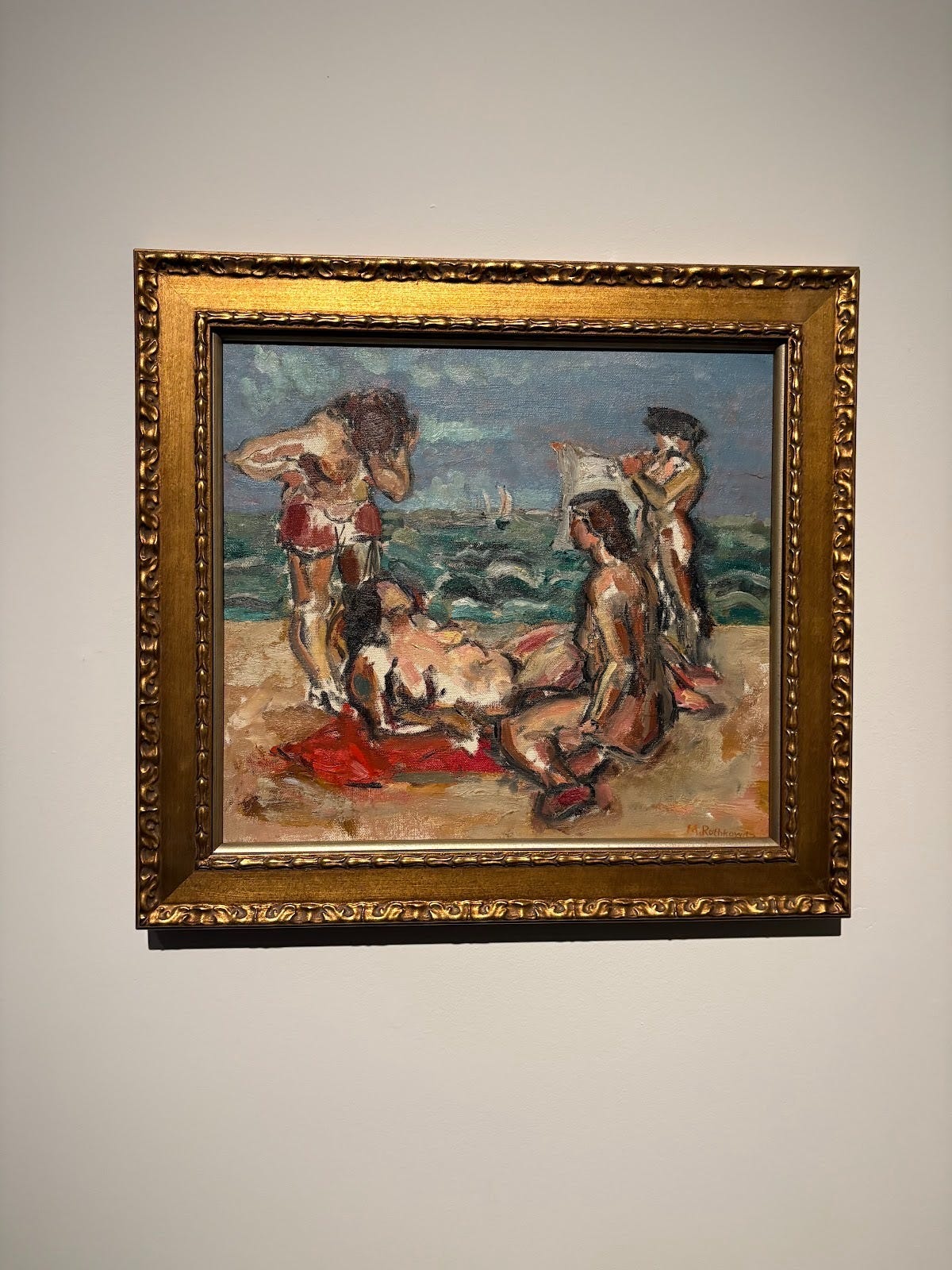
As part of its grand reopening, PAM is currently showing some of Rothko’s early work, which he created while apprenticing under Milton Avery. One of the early paintings is a beach scene featuring four sunbathers, three of whom are apparently nude. It’s figurative and representational. It has lines. It has a fucking sailboat. It’s a world away from the big color blocks of his later career, a few of which hang on the opposite wall.
For the next ten years, Rothko made weird, ugly figurative work that I find charming. A few examples are shown next to the early realistic ones. The colors are muddled, the perspectives are off, and most of them look vaguely unfinished. I can feel him groping for portrait skills and failing. I love to watch him fail how I fail. It’s endearing. From these, he drifted toward surrealism (PAM has a couple of these, too) before he settled into abstraction.
It’s ok for small cities to want heroes (less ok to adopt their intellectual property in contexts that run antithetical to the artist’s intentions, but I digress.). Does ours have to be him?
In an address at the Pratt Institute in 1958, after he had been making color fields for quite some time, Rothko offered a “recipe of a work of art—its ingredients—how to make it—the formula:
There must be a clear preoccupation with death—intimations of mortality ... Tragic art, romantic art, etc., deals with the knowledge of death.
Sensuality. Our basis of being concrete about the world. It is a lustful relationship with things that exist.
Tension. Either conflict or curbed desire.
Irony, This is a modern ingredient—the self-effacement and examination by which a man for an instant can go on to something else.
Wit and play ... for the human element.
The ephemeral and chance ... for the human element.
Hope. 10% to make the tragic concept more endurable.”
I look at a red and green painting of his from this era and measure it against these principles. The painting looks like rectangles. I struggle to locate wit or lust. Maybe there is some tension between the colors. I want to be generous. I hate feeling so stupid. Was it made according to this recipe? Is this what he was really about?
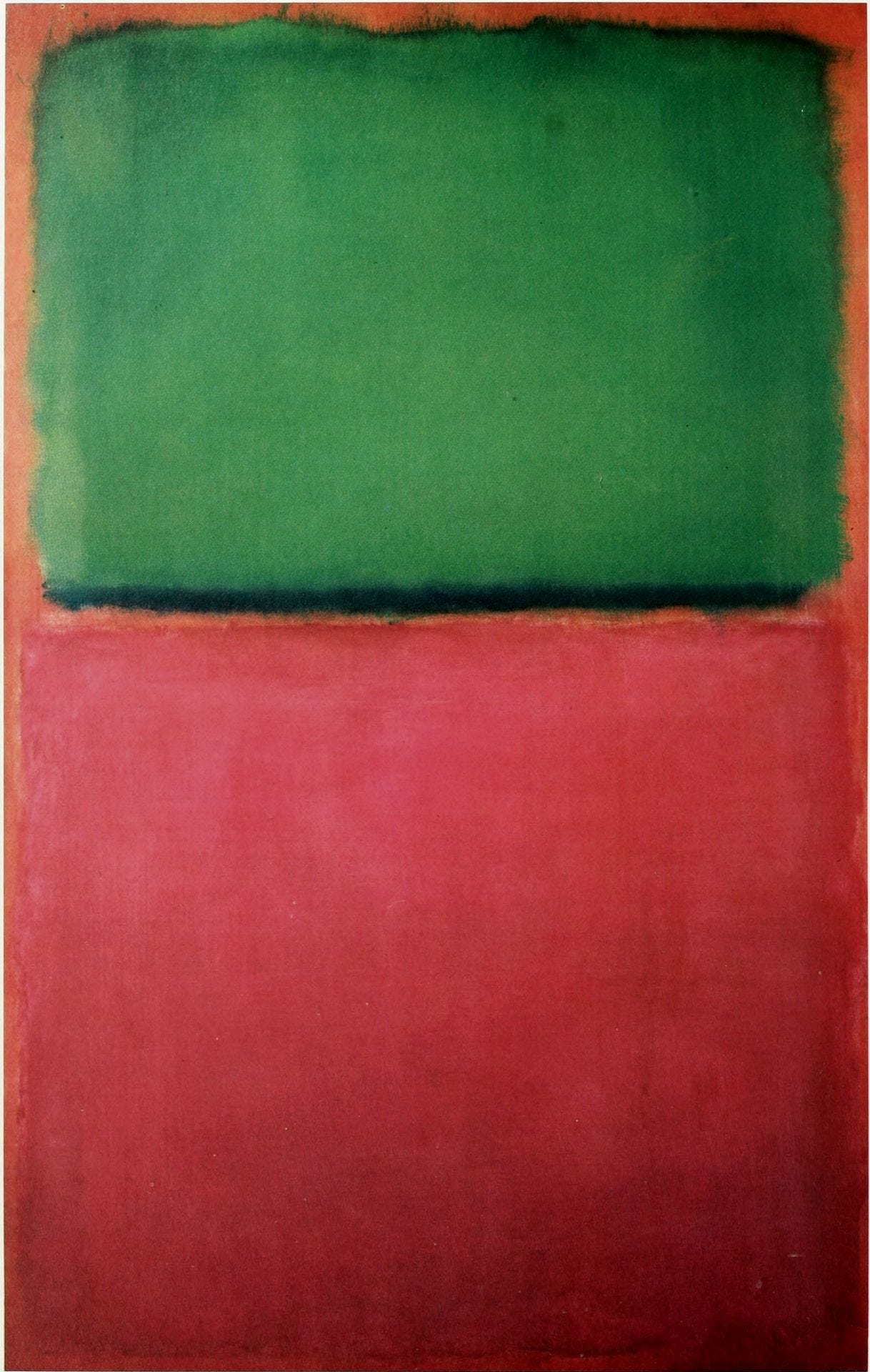
Elsewhere, Rothko described art as an adventure into a mysterious world. “I am not an abstractionist,” he insisted. “I am not interested in the relationships of color or form or anything else. I am interested only in expressing basic human emotions—tragedy, ecstasy, doom, and so on…The people who weep before my pictures are having the same religious experience I had when I painted them.” He was concerned with creating space, we might say now, space for the experience of a feeling, his work a temple for a nondenominational affective fervor.
This fall, Christie’s will auction one of Rothko’s works, No. 31 (Yellow Stripe) (1958). Their appraiser estimates its value at around $50 million. The painting has a cantaloupe orange color field above a crimson one. Both float on a field of candlelight yellow. It measures 6 by 7 feet. When I look at it on my screen, I see some surprising patches of light in the middle of the big swatches of orange and red. Oh, I think, that’s interesting. But I quickly realize these are a feature of the broken screen on my laptop and not evidence of the artist’s fugitive hand.
In one of the documentaries I watch about Rothko, his son cautions against taking everything his father said too seriously.
While A cooks us breakfast every morning, my work is to read something aloud. I sit behind him in a desk chair and read to his back while he cracks the eggs and dresses the toast. For the first few months of our courtship, our morning book was Alice Notley’s Early Work. I don’t quite get Notley, but A loves her. He lives for abstraction and poetics. In fact, he would prefer that everything remain just beyond sense. One day, while I cook dinner, I ask A to read Notley aloud to me. I want to know how it feels. He begins. From this vantage point, the experience is beautiful.
Months later, it is night and the lights are off and I say the words I love you for the first time into A’s ear. I say it to the white triangle of his back. A turns around and kisses me. I love you, he says. He says my name. The next day, we fuck in the gray-white rectangle of the bed in the early afternoon. Our mouths are wet. I cry out. He does. I hold his hands above his head, but it is not about control.
When I leave A’s that evening, I put on Feldman’s Rothko Chapel. The music is spare and resonant. Soaring, open-mouthed tones sung by a single voice, piano sections like meditation bells, soft violin, the sound of blue ribbons unspooling across the avenue as I drive with my windows down past girls working the corners and the fast food signs clicking on and off in the dark. The piece was performed with the musicians lining the walls of the chapel, with the audience in the center. Like Rothko’s paintings behind them, its purpose was total engulfment in an atmosphere of spiritual transcendence. I feel exhausted, almost stoned. I am engulfed in the transcendent relief of having released the truth into A’s ear. I can feel my atomic fabric fraying, but it doesn’t hurt. It feels good.
Otto von Guericke, the 17th century inventor of the vacuum pump, was obsessed with the potential of empty space. Here is a section of his Ode to Nothing:
Nothing contains all things. It is more precious than gold, without beginning and end…comparable to the heavens, higher than the stars, more powerful than a stroke of lightning, perfect and blessed in every way. Nothing always inspires. Where Nothing is, there ceases the jurisdiction of all kings. Nothing is without any mischief. According to Job the earth is suspended over Nothing. Nothing is outside the world. Nothing is everywhere. They say the vacuum is Nothing; and they say that imaginary space—and space itself—is Nothing.
The tricky thing about space is that it is a nothing that is a something. And because he saw his paintings as spatial—not a picture of objects or even shapes in a space, but space itself, imageless and without line or form, not empty exactly, but not full of any thing either—I can’t understand Rothko without it. Describing his Seagram murals, a set of red-heavy color field works commissioned by the Four Seasons restaurant in Manhattan, he said, “They are not pictures. I have made a Place,” suggesting that he was simultaneously a painter and an architect, one whose primary creative concern was space.
I am surprised to find that classical architecture had no use for such nothing-concepts as space. In first century BC Rome, Vitruvius’s seminal Ten Books of Architecture, discussed “architectural orders, mythical and historical precedent, proportion, symmetry, geometry, building location, building materials, and even the damaging effects of moon rays,” but not space.
The term did not enter the lexicon of Western art or architecture until much later, in the early 1900s, when Cubists adopted it as a way to promote their abstract representations of shapes in space and their understanding of the dimensions that governed them. With that, the argument about what exactly space is expanded beyond the disciplines of science and philosophy into art and design.
In 1917, Charles-Édouard Le Corbusier, a Swiss architect, and the painter Amédée Ozenfant developed a new school of painting in response to Cubism, which they thought was decorative trash. They called it Purism, and their objective was the representation of rudimentary forms with no ornamentation. In their manifesto, a brief theory of space appears as part of the Composition section. “A painting should not be a fragment….Therefore we think of the painting not as a surface but as a space,” they say. This was their attempt to make what they painted even more real.
The art critic and painter James Hyde calls this logic “a strategy to make a painting’s composition architectonically whole,” a thought that I can barely get my head around, but which seems to mean that a painting should be understood as a room in its own complete universe—not a window into that room, but the room—or even a universe unto itself. It should stand on its own: complete, whole.
By the 1940s, Le Corbusier had returned to the study of architecture, about which he wrote that “the release of esthetic emotion is a special function of space.” This is almost exactly the way Rothko later talks about his colors. Put another way, the abstract painter Frank Stella says that “the aim of art is to create space—space that is not compromised by decoration or illustration, space in which the subjects of painting can live.”
Rothko even wrote an essay called “Space,” in which he asserts that “Space, therefore, is the chief plastic manifestation of the artist’s attitude toward reality.” He meant you can tell a lot about an artist by how he creates space in his work, to which I might reply, “Okay.”
Hyde connects these three painters as a trinity who hitched the art-historical concept of space to spirituality and religion. “For Le Corbusier,” Hyde writes, “‘ineffable space’ is a sacred union between ‘deserving’ followers and the master artist. With Rothko and Stella, it can be noted that space is an essential link from their painting to religious art, if not religion itself.”
In the morning, A and I are reading a new collection of poems, Black Zodiac by Charles Wright. When I arrive at Rothko among the lines, I nearly drop the book. I am shocked to see his name yet again. Rothko is everywhere lately. It is as if he is communicable, even sexually transmitted.
The poem reads, “Lonesomeness. Morandi. Cézanne, it’s all about lonesomeness. And Rothko. Especially Rothko. / Separation from what heals us / beyond painting, beyond art… Two tone fields, horizon a line between abysses, / Generally white, always speechless. / Rothko could choose either one to disappear into. And did.”
To read the rest (or turn the page to something you like better), pick up a copy of the magazine. Hope to see you soon.